
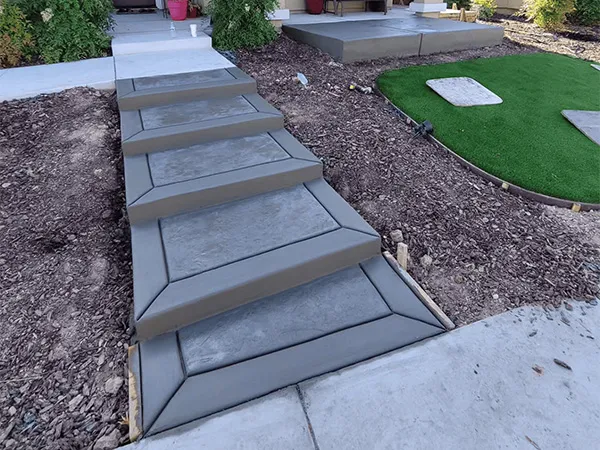
Concrete Walkway Cost in Sacramento: Paths, Sidewalks and Steps (2026)
Plan on $7 to $17 per square foot for a new concrete walkway, HomeGuide’s 2026 installed range. Angi puts the 2026 national average at $2,000. Most homeowners spend $1,600 to $2,400 for a 200 square foot path. Poured concrete steps run $200 to $500 per step in HomeGuide’s guide.
RMR Construction pours concrete walkways and steps as part of yard builds. We have a stake in this work, so the prices here come from published 2026 cost guides. They are national market ranges. The permit rules come from City of Roseville documents and the state building code.
What does a concrete walkway cost per square foot?
A concrete walkway costs $7 to $17 per square foot installed, by HomeGuide’s 2026 concrete sidewalk guide. High-end custom designs reach $20 per square foot. Angi’s 2026 guide lands inside that band. It prices a standard flat finish at $8 to $12 per square foot.
For a whole project, Angi says a 200 square foot walkway costs about $2,000, roughly $10 per square foot. HomeGuide puts the same 200 square feet at $1,400 to $3,400. A 4 foot wide walkway runs $28 to $68 per linear foot in HomeGuide’s guide.
Here are the 2026 ranges for walkways and steps in one place. Every row is a national range, so local labor and your site set the real number.
| What you are pricing | Published 2026 range | Source |
|---|---|---|
| Concrete walkway, installed | $7 to $17 per sq ft | HomeGuide |
| Standard flat finish walkway | $8 to $12 per sq ft | Angi |
| High-end custom walkway | Up to $20 per sq ft | HomeGuide |
| Stamped walkway, 4 ft wide | $10 to $21 per sq ft | HomeGuide |
| Removing old concrete | $2 to $6 per sq ft | Angi |
| Removing old concrete, with disposal | $3 to $8 per sq ft | HomeGuide |
| Poured concrete steps | $200 to $500 per step | HomeGuide |
| Concrete steps, 4 ft wide | $200 to $600 per step | Angi |
| Railing for steps, wood or metal | $300 to $600 | Angi |
Small pours cost more per square foot. HomeGuide says projects under 200 square feet price slightly higher because of minimum concrete delivery fees. Its sidewalk range also sits above the patio figure on the same page. Our concrete patio cost guide covers that bigger slab.
On site, we stake out the line with you before anything is formed. To see how we lay out and pour this work, visit our page on concrete walkways and steps.
What raises the cost of a concrete walkway?
Labor is most of the bill, so anything that adds labor raises the price. Angi puts labor for a 200 square foot walkway at about $1,350. The concrete itself comes to about $250.
Tear-out and haul-off. A replacement starts with breaking out the old walkway. Angi puts removal and disposal at $2 to $6 per square foot, and HomeGuide at $3 to $8. HomeGuide says digging up to 8 inches deep is common when replacing an old sidewalk.
Base prep and compaction. HomeGuide’s size table leaves out prep work such as a gravel base and ground compaction. A 4 inch gravel base runs $10 to $15 per linear foot on walkways up to 4 feet wide.
Clay soil swells when wet and shrinks as it dries, so a firm, compacted base matters more there. For public sidewalks, Roseville requires the soil underneath compacted to 95 percent relative compaction.
Thickness. Angi says most walkways and sidewalks use a standard 4 inch slab. Going thicker costs more. Angi lists a 100 square foot walkway at $800 to $1,200 at 4 inches thick. At 6 inches, it runs $900 to $1,300.
Reinforcement. For light foot traffic, Angi says wire mesh can stand in for rebar. It puts wire mesh at $50 to $200, and rebar at around $100 for a 200 square foot walkway.
Forms and curves. Straight edges are the fastest to form. Angi says custom angles or curves can push labor from about $1,350 to up to $1,800. That is the gap between a standard 18 hour job and a curved one closer to 24 hours.
Finish. We finish walkways and steps for traction. A stamped or stained finish costs more than plain broom-finished concrete. HomeGuide adds $3 to $4 per square foot for stamping and $3 to $10 for staining. Angi says these finishes add $2 to $12 per square foot.
Drainage. A walkway next to the house has to carry water away from it. Section R401.3 of the 2025 California Residential Code covers this. Hard surfaces within 10 feet of the foundation must slope at least 2 percent away from the building. That is about a quarter inch of fall per foot.
Access. Angi says pros typically use a mixer truck on these jobs. On small jobs, a portable mixer on site can eliminate the delivery charge. When a side yard is too tight for equipment, concrete moves by wheelbarrow, and that takes more hours.
How much do concrete steps cost?
Poured concrete steps cost $200 to $500 per step, by HomeGuide’s 2026 guide. HomeGuide puts 5 to 10 poured steps at $1,000 to $5,000 in all. Angi prices 4 foot wide steps at $200 to $600 per step, and the price rises as width increases.
Count the steps. The number of steps comes from the height you need to climb. HomeGuide’s rule of thumb divides that height in inches by 7. A 21 inch rise works out to three steps. At HomeGuide’s per-step range, three poured steps run about $600 to $1,500.
Entry steps and landscape steps. Angi puts standard entry steps at $800 to $2,400 for the concrete alone. A decorative handrail brings that to $1,000 to $3,000. For three to five landscape steps, Angi says you will pay $600 to $3,000 in most cases. Landscape steps are more likely to have longer treads, and Angi notes longer runs can push the price higher.
Railings and landings. Angi lists wood or metal railings at $300 to $600. HomeGuide lists stair railings at $20 to $250 per linear foot. HomeGuide also says most steps over 5 feet tall need a landing platform, which adds cost.
Code limits. Stairs serving a building, porch or deck must meet the 2025 California Residential Code stairway rules. Section R318.7.5.1 caps riser height at 7 3/4 inches. Section R318.7.5.2 calls for treads at least 10 inches deep. Risers in one flight can differ by no more than 3/8 inch.
Section R318.7.8 sets the handrail rule:
“Handrails shall be provided on not less than one side of each flight of stairs with four or more risers.”
The code also calls for a floor or landing at the top and bottom of each flight, with some exceptions. The same stairway section exempts stairways not within or serving a building, porch or deck. Ask your city how that applies to garden steps out in the yard. Either way, we form steps to a consistent rise and run and pour them on footings.
Do you need a permit for a walkway or sidewalk in Roseville?
In Roseville, a private walkway at grade is on the city’s building permit exemption list, with conditions. The public sidewalk in front of the house is different. Work there needs a city encroachment permit.
Roseville’s Permit Exemptions handout is dated January 28, 2025. It lists sidewalks and driveways not more than 30 inches above adjacent grade. They also cannot sit over a basement or story below, or be part of an accessible route. The list names sidewalks but not steps, so ask the city before you build a set of steps.
The sidewalk along the street sits in the public right of way. Roseville says an encroachment permit is required for improvements or staging construction there. The city’s examples include sidewalk repair.
City standards also shape the price of that work. The city’s requirements sheet for minor sidewalk and driveway permits includes these rules:
- The soil under the sidewalk is compacted to 95 percent relative compaction.
- Sidewalk is six inches thick.
- New sidewalk is doweled and epoxied to the existing concrete.
- Concrete is not poured or finished in the rain.
- Work starts only after 48 hours notice to the Public Works Inspector.
That is a thicker slab than the standard 4 inch walkway Angi describes, plus an inspection to schedule. Get it in writing who applies for the permit and whether it sits inside the quote.
Other cities set their own rules, so check with the city or county that maintains your street. HomeGuide notes that homeowners are often responsible for sidewalk repairs, though some cities handle that work. If you live in Orangevale, our page on concrete sidewalks in Orangevale covers that area.
Should you repair or replace an old walkway?
Repair a walkway when the slab is sound and the damage sits in one area. When it has failed along its length, replacement is usually the better spend. HomeGuide puts sidewalk repair at $3 to $8 per square foot for moderate cracks. Removing and replacing runs $10 to $25 or more per square foot.
Resurfacing gives a worn but solid walkway a new top layer. HomeGuide prices concrete resurfacing at $3 to $7 per square foot. Our concrete repair and resurfacing work also replaces single broken sections while the rest of the walkway stays.
A replacement is the time to fix the route and width. Concrete lasts when it is built well. HomeGuide says a concrete walkway lasts 25 to 50 years on average. It gives concrete steps 30 to 40 years with proper care.
Planning a walkway with the rest of the yard
A walkway is simplest to build as part of a whole yard plan. We plan yards in order: grade and drainage first, then underground irrigation and conduit. Concrete and walls come next, then turf, sod, rock and planting. Pipe sleeves that cross under a new walkway go in before the pour.
Edges finish the look. A concrete curbing border holds rock or turf back from the walkway. HomeGuide lists landscape curbing at $5 to $18 per linear foot. Spaced concrete slabs set into planting beds or turf are another walkway style we pour.
One customer’s Google review describes “turf with concrete steps” and a “front patio all in concrete” in one yard project. The same review says “everything was done correctly.”
Our California contractor license is CSLB #1088628. Estimates are free, and you get a written quote after an on-site walk-through. See how we build walkways and steps, or request a free estimate.